Short answer
To smoke beef ribs, season them with coarse salt and pepper, smoke at about 250 degrees Fahrenheit until the bark sets, wrap if needed, and pull at 203 degrees Fahrenheit or when a probe slides in like soft butter. Plan on six to eight hours.
To smoke beef ribs, season them with coarse salt and black pepper, smoke them at about 250 degrees Fahrenheit, and pull them when a probe slides in with almost no resistance, usually near 203 degrees Fahrenheit after six to eight hours. The bark is the dark crust that forms on the outside. This guide explains how to choose, season, smoke and rest beef ribs.
What are beef ribs for smoking?
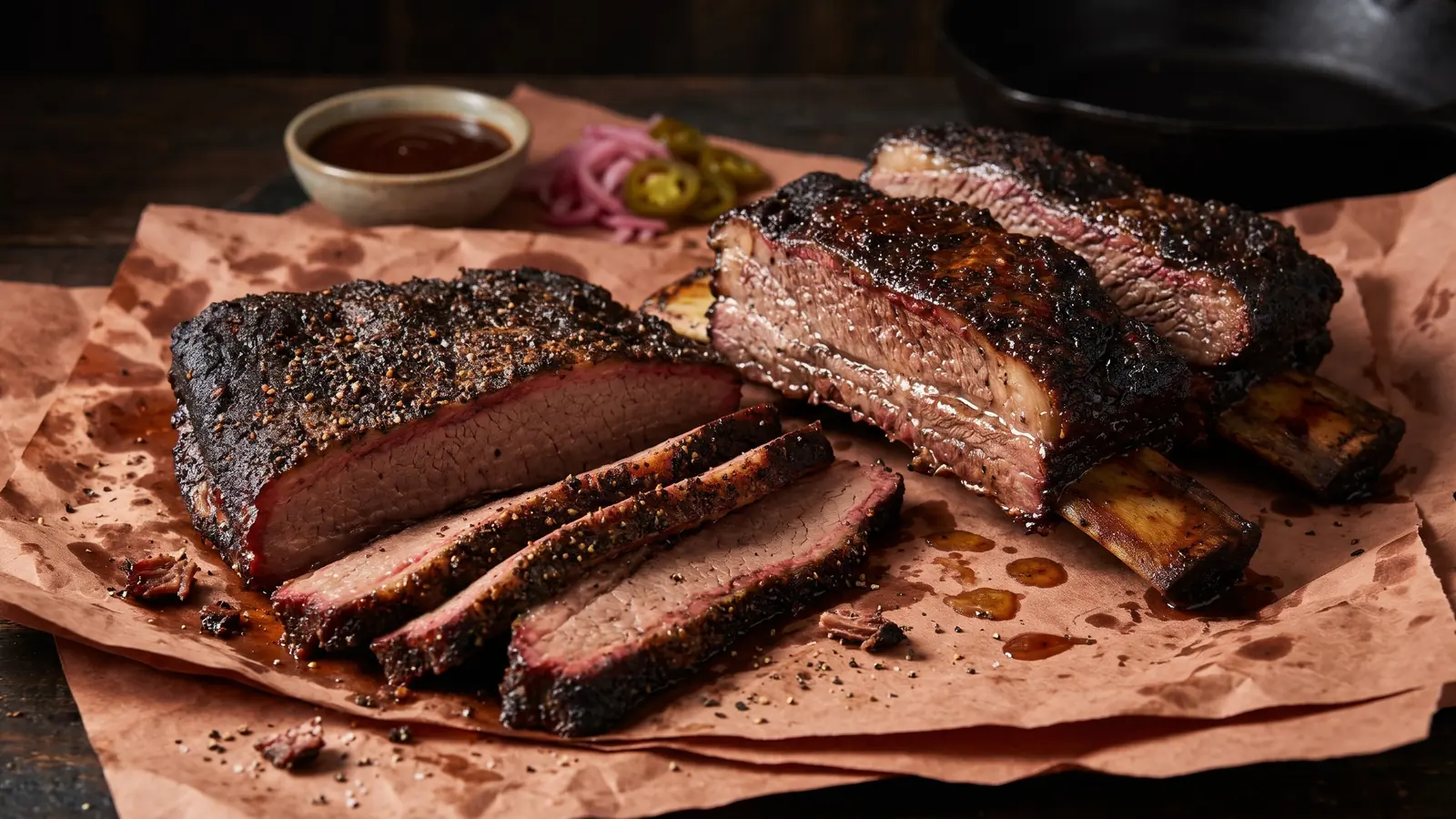
Beef ribs for smoking are either plate ribs, the large “dinosaur” bones from the lower rib section, or short ribs, a smaller cut from the same area. Both are meaty and fatty, which suits long smoking.
| Cut | Where it comes from | Size | Typical smoke time |
|---|---|---|---|
| Plate short ribs (dinosaur ribs) | Plate section, ribs 6 to 8 | 3 to 4 bones, about 3 to 5 lb | 6 to 8 hours |
| Chuck short ribs | Chuck section near the shoulder | Smaller, 3 to 4 inches | 4 to 6 hours |
| Back ribs | Rib roast bones left after cutting ribeye | Thin meat | 3 to 4 hours |
Plate ribs are the showpiece, with a large piece of meat on each bone. Back ribs are cheaper but have less meat. Choose a slab with thick meat, even fat and a surface with no dry patches.
How do you season beef ribs for the smoker?
The standard way to season beef ribs is a dry rub of coarse kosher salt and coarse black pepper, in roughly equal parts, applied at least an hour before smoking. This salt-and-pepper style is common in Texas barbecue because it lets the beef and the smoke lead.
Trim hard fat from the surface and remove the silver membrane from the bone side if the butcher left it on. Pat the meat dry, then press the seasoning on all sides. Garlic powder, onion powder or paprika are common additions, but they are optional. Seasoning the night before gives the salt time to work into the meat.
What temperature and wood should you use to smoke beef ribs?
Smoke beef ribs at 250 to 275 degrees Fahrenheit with a clean-burning hardwood such as post oak, hickory or pecan. A steady fire matters more than the exact number.
- Post oak: mild and steady, widely used for Texas beef.
- Hickory: stronger, with a bolder smoke.
- Pecan: sweet and gentle, good mixed with oak.
- Mesquite: very strong, so use a small amount.
Keep thin blue smoke coming from the stack. Thick white smoke leaves a bitter taste on the bark.
How do you smoke beef ribs, step by step?
To smoke beef ribs, trim, season, smoke bone side down until the bark is set, optionally wrap, and continue until probe tender. The process takes six to eight hours for plate ribs.
- Heat the smoker to 250 degrees Fahrenheit (120 degrees Celsius).
- Trim and season the ribs, and let them sit for at least an hour.
- Place the ribs bone side down on the grate, away from direct flame.
- Smoke undisturbed for about three hours, until the bark is dark and does not smudge when pressed.
- Spritz lightly with water or apple juice if edges look dry.
- Check the temperature. If the meat has stalled and the bark is set, wrap it tightly in pink butcher paper or foil.
- Continue cooking until the meat reaches about 203 degrees Fahrenheit (95 degrees Celsius) and a probe slides in with little resistance.
- Rest, wrapped, for 30 to 60 minutes.
- Slice between the bones and serve.
What is the stall and how do you get past it?
The stall is a pause in temperature rise that happens because moisture evaporating from the meat’s surface cools it as fast as the smoker heats it. It usually appears between 150 and 170 degrees Fahrenheit and can last an hour or more.
Three ways to handle the stall:
- Wait it out. The temperature will start climbing again. This keeps the best bark.
- Wrap the ribs. Butcher paper or foil traps moisture and speeds things up.
- Raise the heat by 25 degrees Fahrenheit, which shortens the stall at some cost to texture.
Do not open the lid repeatedly while waiting. Each opening drops the temperature and prolongs the cook.
Butcher paper or foil: which wrap for beef ribs?
Pink butcher paper keeps the bark firmer and lets some steam escape, while foil seals everything in and gives softer, wetter ribs. Either works, and neither is required.
| Butcher paper | Foil | No wrap | |
|---|---|---|---|
| Bark | Firm, holds shape | Soft | Hardest and darkest |
| Moisture | Good | Highest | Lowest |
| Speed | Faster | Fastest | Slowest |
| Best for | Texas style | Rescuing a dry cook | Maximum crust |
Many Texas cooks prefer butcher paper because it keeps the crust intact. Foil is handy when time is short.
How do you know beef ribs are done?
Beef ribs are done when a thin probe slides into the meat between the bones with almost no resistance, typically around 203 degrees Fahrenheit. The meat should shrink back from the ends of the bones.
Do not rely on the thermometer alone. Different ribs reach tenderness at different temperatures, sometimes between 200 and 210 degrees Fahrenheit. If the probe feels tight, wait 20 minutes and test again. Ribs that are pulled early are chewy, and ribs that are overcooked fall apart without holding their shape.
How do you slice and serve smoked beef ribs?
Slice smoked beef ribs after resting, cutting between the bones with a sharp knife. Serve them on butcher paper or a board with pickles, raw onion, white bread and a simple side such as beans or potato salad.
Leftovers keep three to four days in the refrigerator. Reheat wrapped in foil in a low oven, adding a spoon of beef stock to keep the meat moist. Chopped leftover rib meat makes a good filling for sandwiches and baked potatoes.
Are smoked beef ribs on the menu at Bud’s House of Meat?
Beef ribs are not on the recorded menu of Bud’s House of Meat in Houston. The Clover ordering page, read on November 11, 2026, lists brisket instead: the Smoked Brisket Dinner at $19.95 and Brisket (1/2 lb) at $13.50, each available lean or loose (with fat).
Texas Monthly describes barbecue cooked over post oak at the store. The fresh meat counter is not itemised online, so ask whether raw beef ribs are in stock. Check the menu page and the hours and location page, and call (713) 733-4363 before visiting. Prices and items can change, and this guide takes no orders.
Common questions
What temperature should you smoke beef ribs at?
Most cooks smoke beef ribs at 250 to 275 degrees Fahrenheit. Lower than that stretches the cook for hours, and much higher risks dry meat before the connective tissue has melted. Keep the temperature steady rather than chasing a precise number.
Do you need to wrap beef ribs in butcher paper?
No, wrapping is optional. Wrapping in butcher paper or foil after the bark sets helps push through the stall and keeps the meat moist, while skipping it gives a firmer, darker crust. Many cooks wrap only if the bark looks dark enough.
What is the stall when smoking beef ribs?
The stall is a period, often around 150 to 170 degrees Fahrenheit, when the internal temperature stops rising for an hour or more because moisture is evaporating from the surface. It is normal, and patience or a wrap gets the meat through it.
Which wood is good for smoking beef ribs?
Post oak, hickory and pecan are common choices for beef because they burn clean and add a steady smoke flavor. Mesquite is stronger and is usually used sparingly. Fruitwoods are milder and sometimes mixed with oak.
How long do you rest smoked beef ribs?
Rest them for 30 to 60 minutes wrapped in paper and a towel, in an empty cooler or a warm oven. Resting lets the juices settle so they stay in the meat when you cut.
Planning a visit? Start with Bud's Meat Market on Cullen: address, opening hours, menu and directions in one place.
This article is general information from an independent guide, not from Bud's House of Meat itself. For the store’s current details see hours and location.